Can a Water-Damaged Phone Be Repaired?
Yes, many water-damaged phones can be repaired, but the odds depend on how fast you act, what liquid got inside, and how long it sat. Fresh water caught early is the best case. Salt water, pool water, and sugary drinks leave residue that speeds up corrosion.
Water resistance ratings like IP67 and IP68 help, but they are not a promise. Seals weaken with age, drops, and previous repairs, and standard manufacturer warranties generally do not cover liquid damage. That makes a local repair the most practical path for many people.
The real enemy is corrosion, not the water itself. Minerals and moisture react with powered circuits, and the damage can keep spreading for days, even if the phone seems fine at first. That delayed failure is why a phone that works after a spill should still be checked.
What Should You Do First When Your Phone Gets Wet?
Power the phone off immediately and leave it off. Electricity flowing through wet components is what causes most short circuits. Then follow these steps:
- Do not charge it or plug it into a computer, even to check whether it works.
- Remove the case and pull the SIM tray to let air circulate.
- Wipe off the outside and gently tap out excess liquid with the charging port facing down.
- Skip the hair dryer, oven, and microwave, because heat can warp seals and damage the battery.
- Bring it in for a professional inspection as soon as you can.
For a more detailed timeline, see our post on what to do in the first 24 hours after phone water damage.
What Parts Does Water Damage in a Phone?
Water usually damages the parts closest to openings first, along with the circuits that carry power. Common failures include:
- Charging ports and charging circuits, which corrode quickly because they carry current.
- Speakers and microphones, which sit right behind openings in the frame.
- Displays, which can show lines, dark spots, or flickering as moisture spreads.
- Cameras, which may fog up or struggle to focus if liquid gets behind the lens.
- Batteries, which can swell or drain quickly after exposure and should be handled carefully.
Because one failure can hide another, a full diagnostic is more useful than replacing the first part that stops working.
Does Putting a Wet Phone in Rice Work?
No, rice is not a reliable fix, and Apple advises against it. Rice only absorbs surface moisture, it cannot reach liquid trapped under shields and connectors, and grains or starch dust can get stuck in ports.
The bigger problem is time. Waiting two or three days in a bag of rice gives corrosion a head start on the logic board. A phone that powers on after drying can still fail weeks later, because the residue is still inside.
How Water Damaged Phone Repair Works in Columbus, Ohio
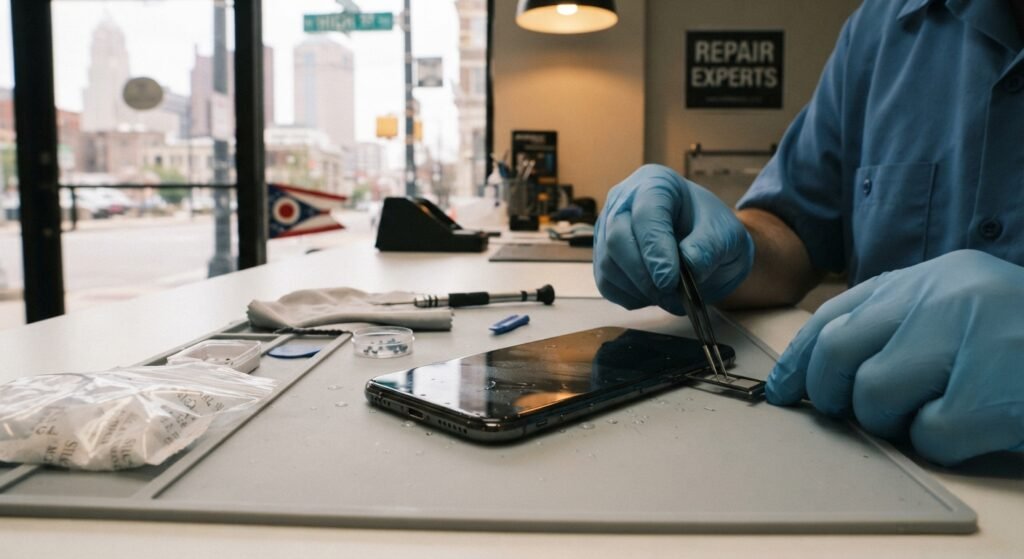
Professional water damage repair starts with opening the phone and inspecting the board, not guessing from the outside. At our Clintonville shop, a technician checks liquid contact indicators, looks for corrosion, and tests the battery, screen, and charging circuit. Typical steps include:
- Disconnecting the battery to stop further shorts.
- Cleaning the logic board and connectors to remove residue and corrosion.
- Testing the screen, battery, charging port, speakers, microphone, and cameras.
- Board-level micro-soldering to repair or replace damaged components when needed.
After the diagnostic, you get an upfront quote, so you can decide before any work begins. Liquid damage usually takes longer than a screen swap, so see how long phone repair takes in Columbus for typical timelines, or visit our phone repair page for the full list of services.
Should You Repair a Water-Damaged Phone or Replace It?
Repair usually makes sense when the damage is limited to one or two parts, like a charging port or speaker, or when you need to save photos and data. Replacement may be the better choice if the board is heavily corroded or the phone is old and already struggling.
Think about what the phone is worth to you, not just what it costs. A recent model with a single damaged part is usually a strong repair candidate, while an older phone with widespread corrosion may not justify the expense.
If a phone that stopped charging after a spill is your main symptom, our guide to why a phone stops charging explains the common causes. For iPhone owners, our article on whether to repair your iPhone or buy a new one walks through the decision.